Merchant Settings
How To Configure Merchant General Settings?
The General Settings page lets you customize your store’s operational rules, such as Order Scheduling and specific Delivery Fees. You can also define Custom Charges to be applied to the customer at checkout for your store. Properly configuring this section ensures that orders follow your business rules automatically and customers receive clear, consistent information at checkout.
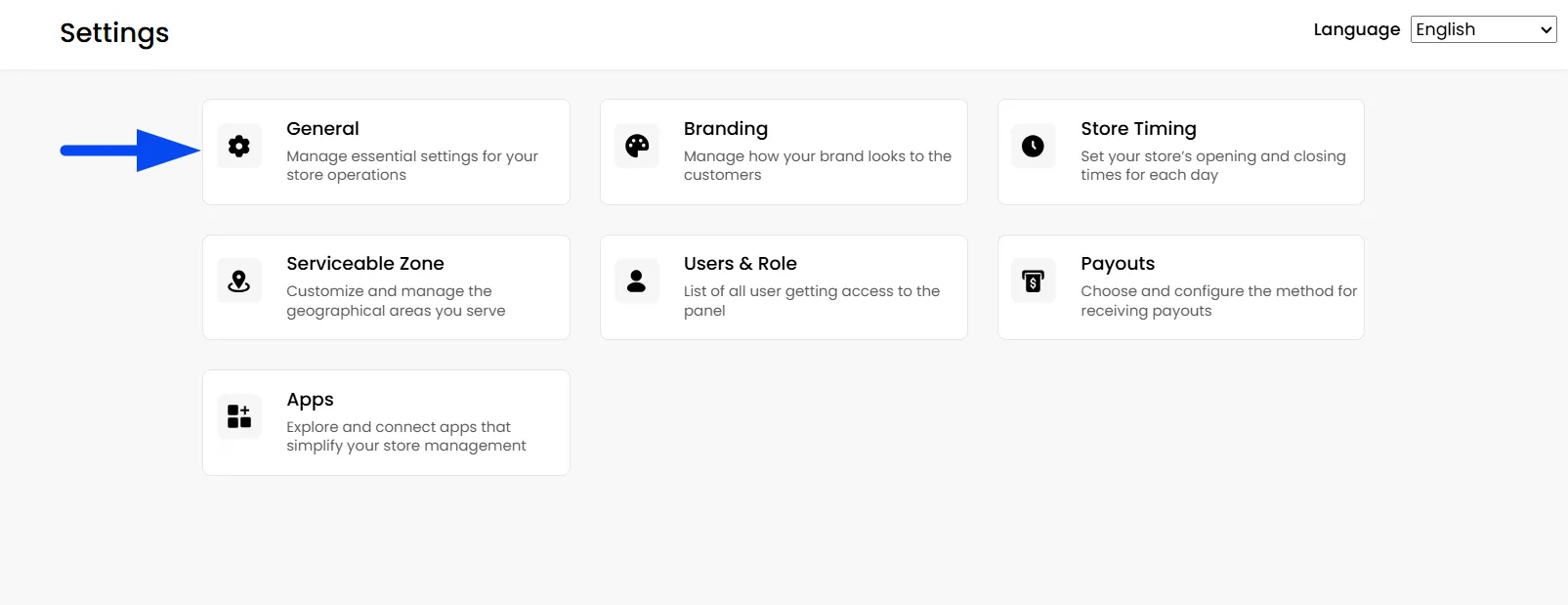
- On the Merchant panel, click on "Settings"

- Then click "General Settings"
This feature allows customers to choose a specific date and time for their orders during the checkout process, in accordance with the availability settings configured in the Store Timing section.
Note: It's mandatory to enable this functionality, particularly for service-oriented businesses. If the option is not readily visible in the General Settings, kindly request the Administrator to activate it through the Order Settings. Ensure that your business hours are accurately set within the Store Timing section.
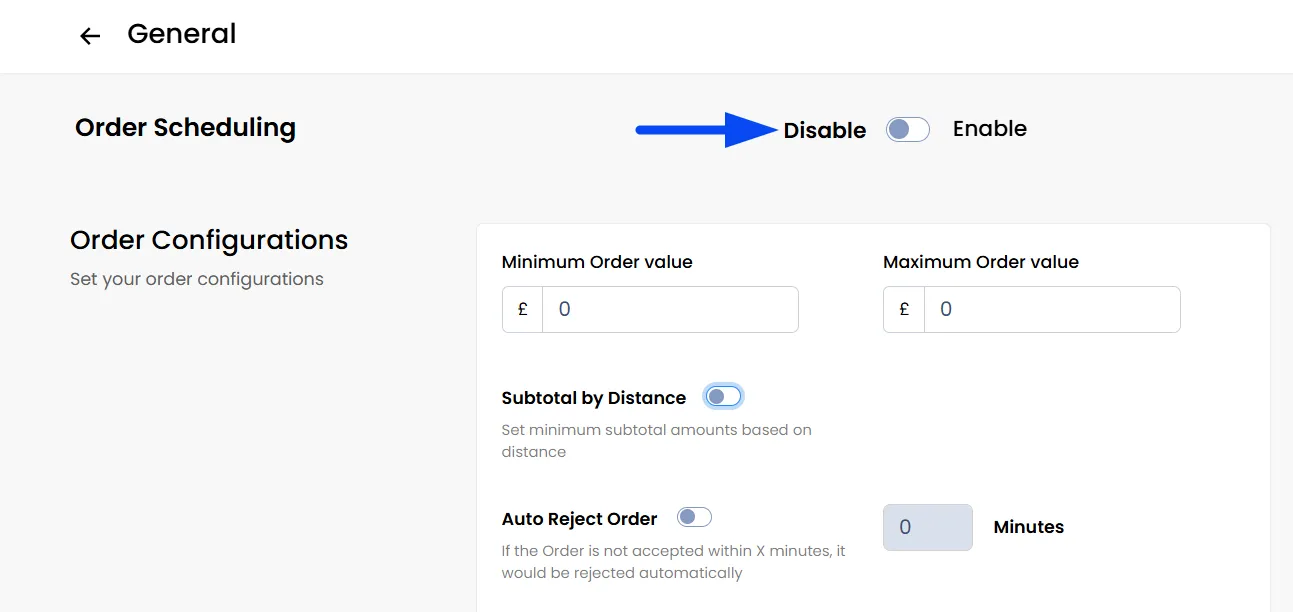
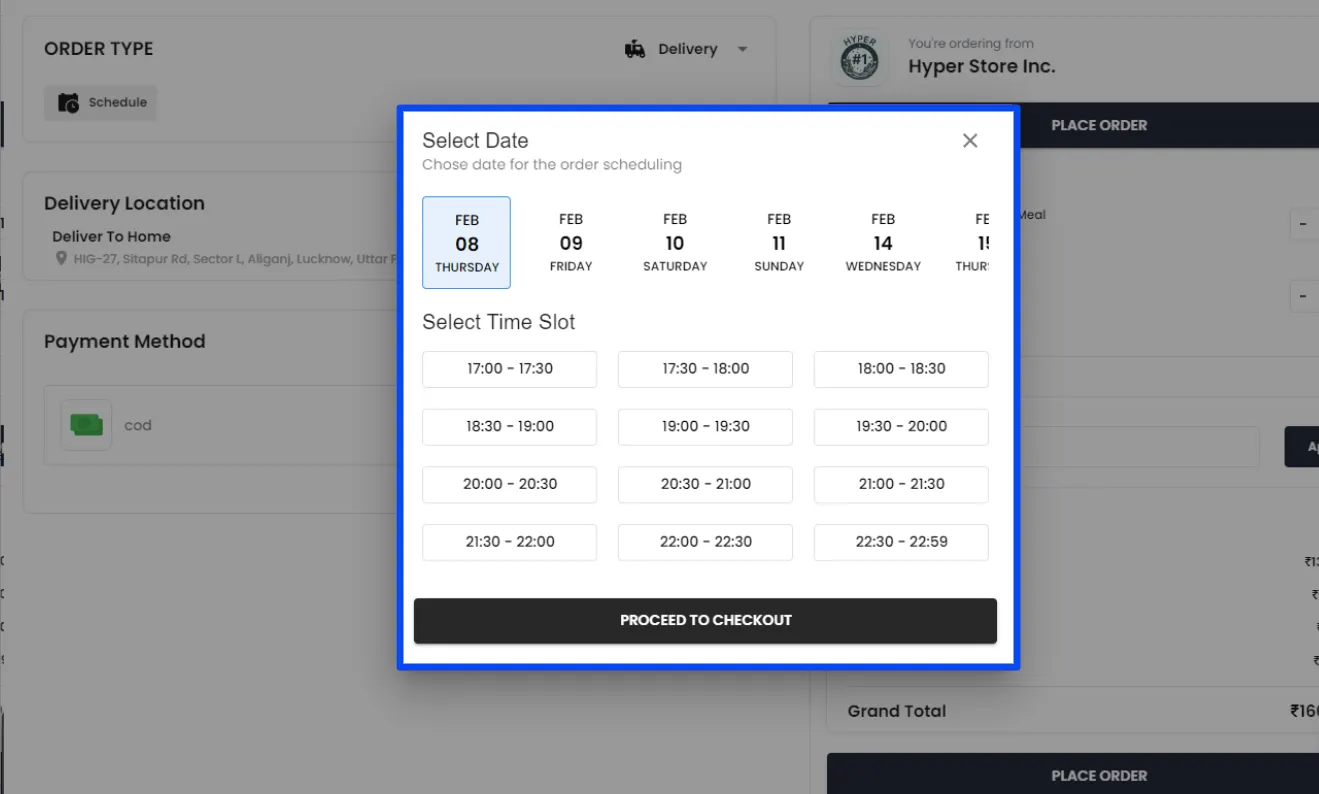
This setting requires customers to select a specific date and time for checkout rather than opting for instant fulfilment. It is particularly crucial for service merchants as it ensures better coordination and scheduling of appointments.

- Minimum Schedule Days: This setting allows you to establish the minimum advance notice required from the current date for scheduling orders. For instance, if you set this to 2 days, customers placing orders today must select a date at least 2 days in the future.

- Maximum Schedule Days: This setting enables you to define the maximum number of days customers can choose from the current date. For example, if set to 7 days and the minimum schedule days was set to 2, customers will have 5 days to choose from after the initial 2-day period.

- Schedule from opening time: This parameter specifies the minimum amount of time required from your store's opening time for each scheduling day.

- Schedule from Closing Time: Similar to the above, this parameter determines the minimum time required from your store's closing time for each scheduling day.

Minimum Schedule Hours from Current Time: This criterion establishes the minimum duration required from the current time of customer order placement for same-day scheduling, accounting for the Minimum Schedule Days set to 0 above.

Slot Span: Allocate availability in predetermined time slots based on the duration required to complete each booking. For example, if each booking takes 30 minutes, distribute availability in 30-minute slots for customer selection.

Slot Booking: Activate this feature to allow multiple bookings within each time slot. For example, if two bookings are permitted per 30-minute slot, once two bookings are made for a specific time slot, it becomes unavailable for additional bookings.

- Minimum Order Value: This setting enables you to establish the minimum subtotal value required for customers to proceed with checkout.

- Maximum Order Value: This setting empowers you to define the maximum subtotal value allowed for customers to proceed with checkout.

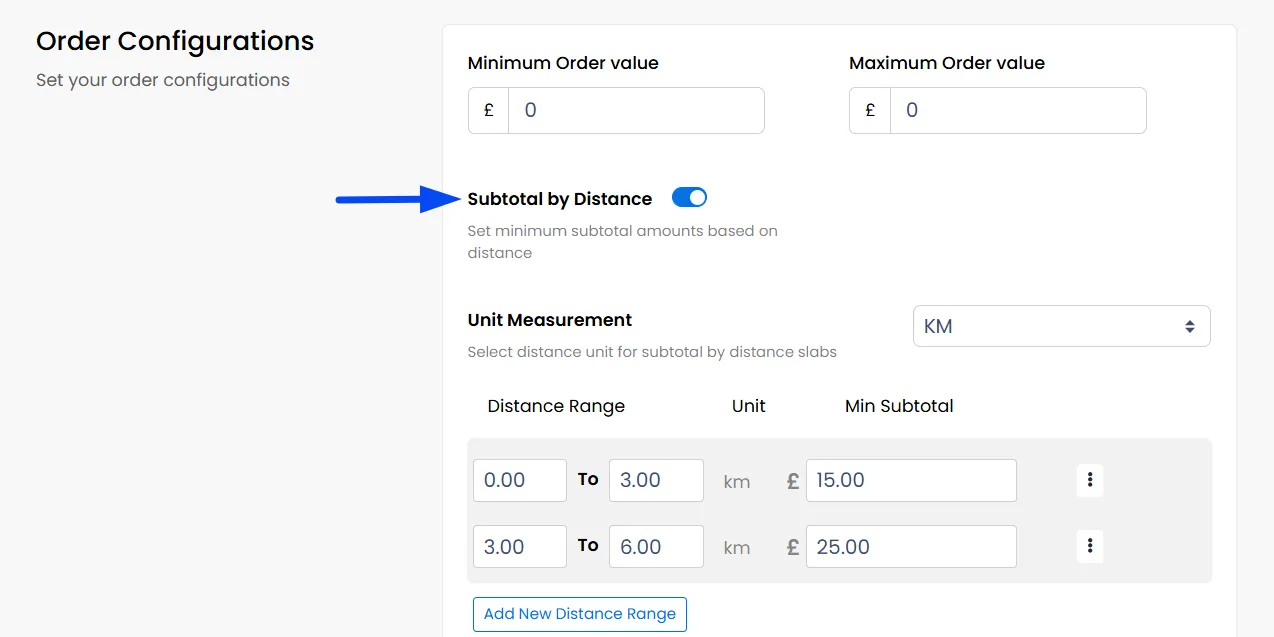
When enabled, you can define minimum order subtotals based on delivery distance.
Example:
- 0–3 km → Minimum subtotal £15
- 3–6 km → Minimum subtotal £25
This helps balance delivery costs for longer distances.
- Auto Reject Order: Automatically mark orders as rejected if they are not accepted by the store within a specified timeframe.

- Auto Accept Order: This feature automatically accepts all incoming orders, eliminating the need for manual acceptance.

Set the default preparation time for orders which you can customize while accepting them. Riders should be shown the order preparation time to coordinate their arrival at the store accordingly, minimizing unnecessary waiting time outside the store.

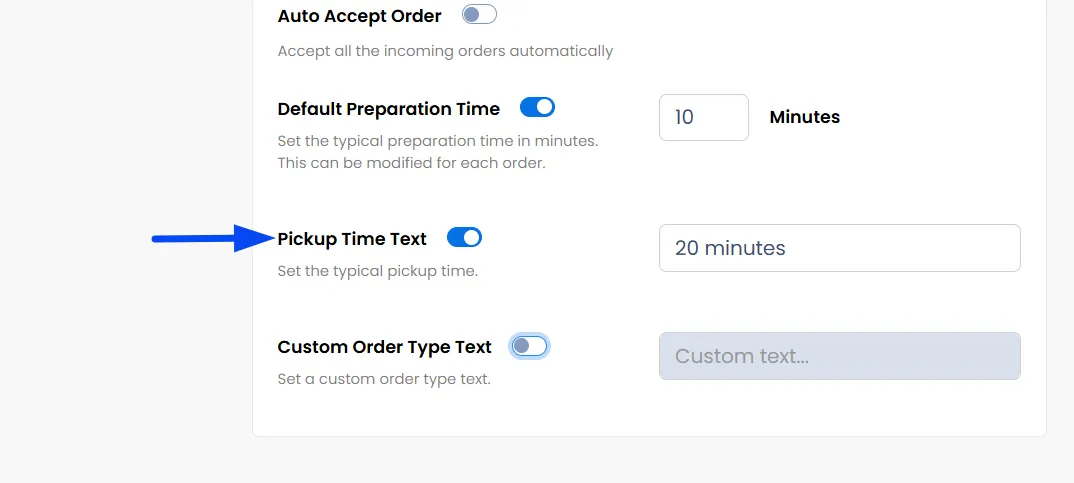
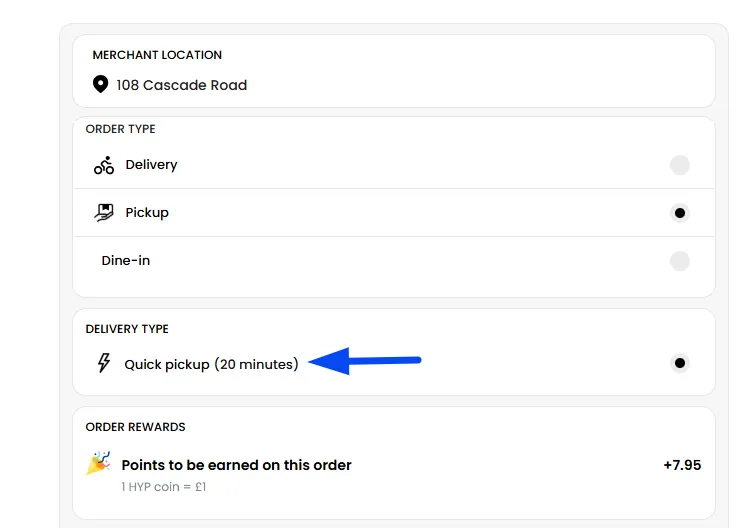
Set the Pickup time text which would be shown to the customers at checkout when they select the order type as "Pickup."
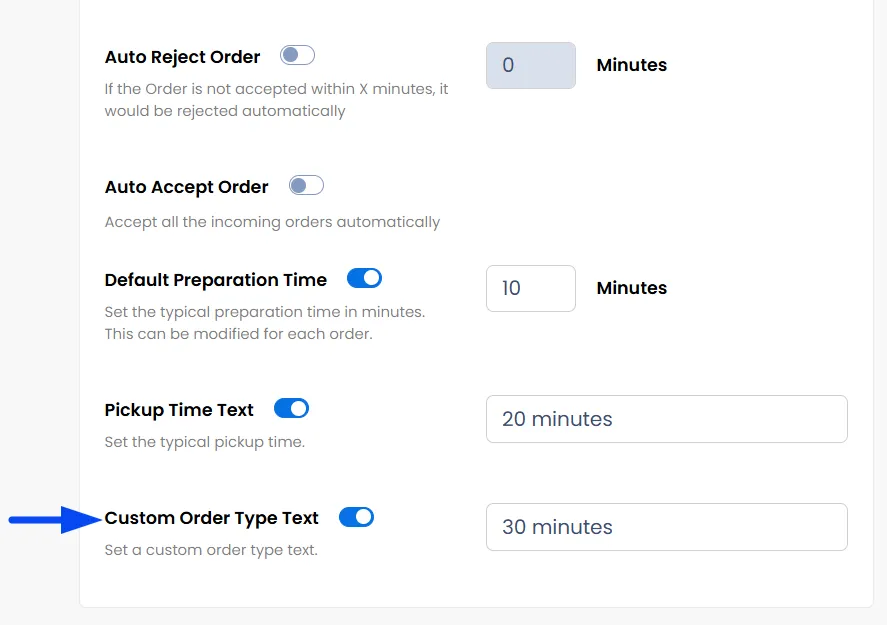
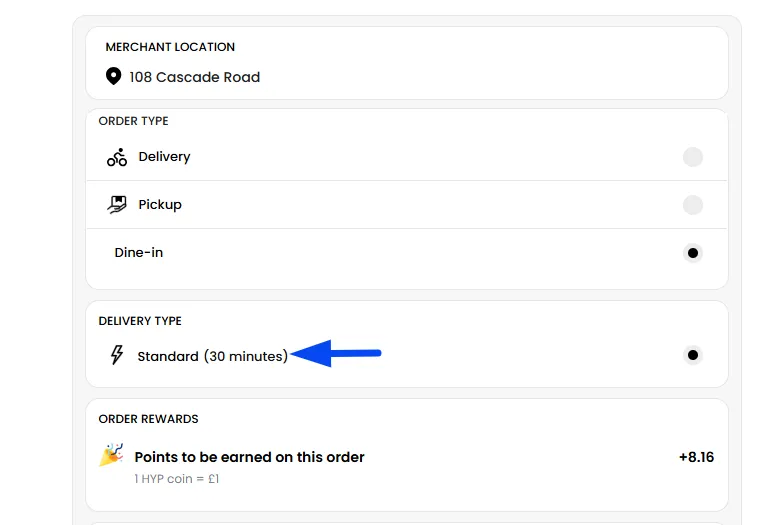
The Custom Order Type Text option allows you to display additional informational text for the custom order type shown at checkout. This setting does not rename the order type itself; instead, it helps you communicate helpful context or timing details to customers when they select the custom order option.
The custom order type is a flexible order type which you can rename to suit your business logic. For example if you offer "Dine In" at your store you can rename it to the custom order type to "Dine In." You can rename the order type within the Order settings in the Admin panel.
There are four types of delivery fees from which the merchant can choose from based on their business logic: None, Fixed, and Set Distance Slabs and Per Unit.
- None: No delivery fee is charged. You can enter an expected delivery time displayed on your storefront on ordering channels.

- Fixed: Set a fixed amount for delivery charges, along with the expected delivery time displayed on your storefront on ordering channels.

- Set Slabs: Establish delivery fees based on the distance from which the customer is placing their order by creating distance range slabs. For instance, you can define slabs such as 0-5 miles, 5-10 miles, and 10-20 miles, alongside mentioning the expected delivery time for each range. When a customer orders from a distance of 3 miles, they fall within the 0-5 mile slab range. Consequently, they will be charged the delivery rate associated with this range, and the expected delivery time displayed on ordering channels will correspond to this range. Similarly, if a customer orders from a distance of 13 miles, they fall within the 10-20 mile range slab. The same process applies as described above.

Click on "Add New" to include additional distance slabs.

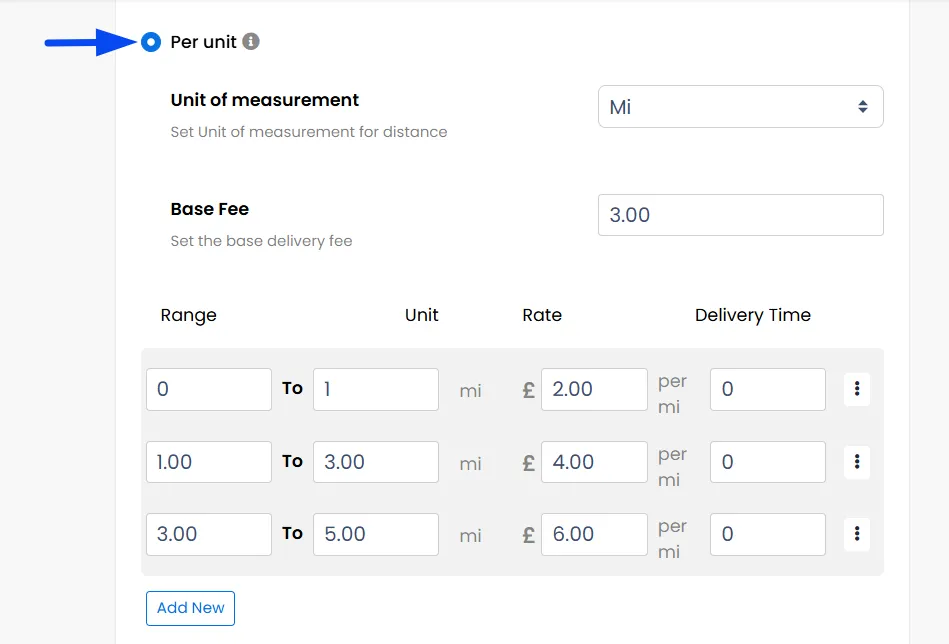
- Per Unit Distance-Based Delivery Fees: The Per Unit delivery type calculates delivery charges dynamically based on the exact distance from which the customer is placing their order.
For example, you can define distance ranges such as 0–1 mile, 1–3 miles, and 3–5 miles, each with a specific rate per mile and an associated delivery time. Additionally, you can set a base fee, which ensures a minimum delivery charge is applied when the calculated fee is lower than the base amount.
When a customer places an order from 1.5 miles away, the system calculates the delivery fee in parts:
- The first 1 mile is charged using the 0–1 mile rate.
- The remaining 0.5 mile is charged by simply multiplying 0.5 with the rate set for 1-3 mile. These amounts are added together to form the final delivery fee. If this calculated total is lower than the base fee, the base fee is applied instead.
Apply a tax percentage on top of the delivery fee.
Note: Request the Administrator to specify whether your store taxes should be inclusive or exclusive on the customer's cart.

Receive instant alerts for new orders placed on your platform, ensuring prompt attention and efficient order management.
- Email: Input the email addresses where you wish to receive incoming order alerts. You can add multiple emails separated by a comma.

- SMS: Provide the phone number where you want to receive incoming order alerts.

Utilize this feature to seamlessly add external fees to customers during checkout, such as your packaging fees, global product taxes, and any other customized charges.
Note: Kindly request the Administrator to include your desired fees under Order Settings to gain access to configure them.

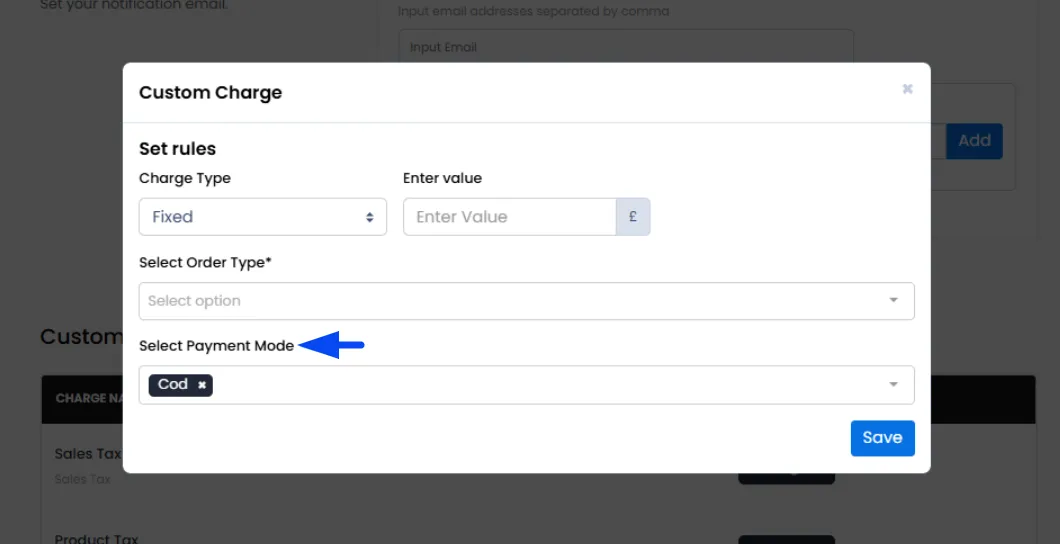
- Charge Type: Select whether the charge should be fixed or a percentage based on the order subtotal.

- Enter Value: Input the specific value for the charge

- Select Order Type: Select the order types in which this extra charge should be added.

Select Payment Mode: Select whether the coupon will be applied based on the Payment method.
Finally, "Save" the charge so that it can be applied to the customers at checkout.
Lastly, click Save and the general settings are successfully configured.

3. Then, click "General"

4. To begin using Order Scheduling, you need to enable this feature in your settings.

5. Force Scheduling: This feature allows all the orders to be scheduled. Customers can only place orders by scheduling the delivery date and time.

6. Set Day Range for Order Scheduling: In this section, you can define the minimum and maximum schedule days. For example, setting Minimum Schedule Days to 0 and Maximum Schedule Days to 30 means customers can schedule an order starting from today up to 30 days in the future.

7. Set Time Range for Order Scheduling: Here, you can specify the opening and closing times during which customers can schedule their orders.

8. Minimum Schedule Hours From Current Time: This feature allows you to define the minimum time interval required before an order can be scheduled from the current time. For example, setting this value to 2 hours means that users will only be able to schedule an order at least 2 hours ahead from the present moment.

9. Slot Span: This setting allows you to define the duration of each time slot for scheduling orders. For instance, you can set a slot span of 30 minutes, providing customers with convenient options to choose from.

10. Slot Booking: Within Order Scheduling, you have the flexibility to enable or disable slot booking. Enabling slot booking allows you to limit the number of bookings per slot, ensuring a manageable workload for your business. By understanding and configuring these settings, you can effectively utilize the Order Scheduling feature to provide your customers with greater convenience and improve their overall experience on your multi vendor marketplace.

11. Under the order configurations section. Put in minimum order value and maximum order value for every order placed in your store.

12. Next, we have an option to enable auto reject order which gives us the option to set time in minutes under which if the order won't be accepted, it would be rejected automatically.

13. Meanwhile you can also enable the auto accept order button, this will allow you to accept all the incoming orders automatically.

14. Moving onto the delivery configurations section. You can enable or disable delivery time display on the storefront for customers.

15. Click here.

16. Fixed allows you to enter a fixed amount which will be charged as delivery fee and the delivery time.

17. Set slabs allows to select unit of measurement as kilometres or miles. Now to add slab you need to set a range, delivery fee and delivery time it will take the driver to complete the delivery. You can add multiple slabs by clicking add new.

18. Now, you can enable or disable delivery tax. If there are taxes on delivery, you can add a percentage to each order.

19. Next, we have a notification section in which we need to input email addresses separated by comma on which we want to receive all the mails related to our online store.

20. Lastly, click "Save"

21. The general settings is successfully configured
22. Now you can explore and configure other settings

Related Articles
Branding
How To Add Your Branding? Your store's branding is its visual identity. It's what makes your storefront unique and recognizable to customers. This section is where you upload your two most important visual assets: your store Logo and your Cover ...Store Timings
Navigating to the Store Timings page On the Merchant panel, click on "Settings." Then click "Store Timing" within the settings section. How To Configure Your Store Timings? Enable the business hours setting to configure your opening and closing ...